
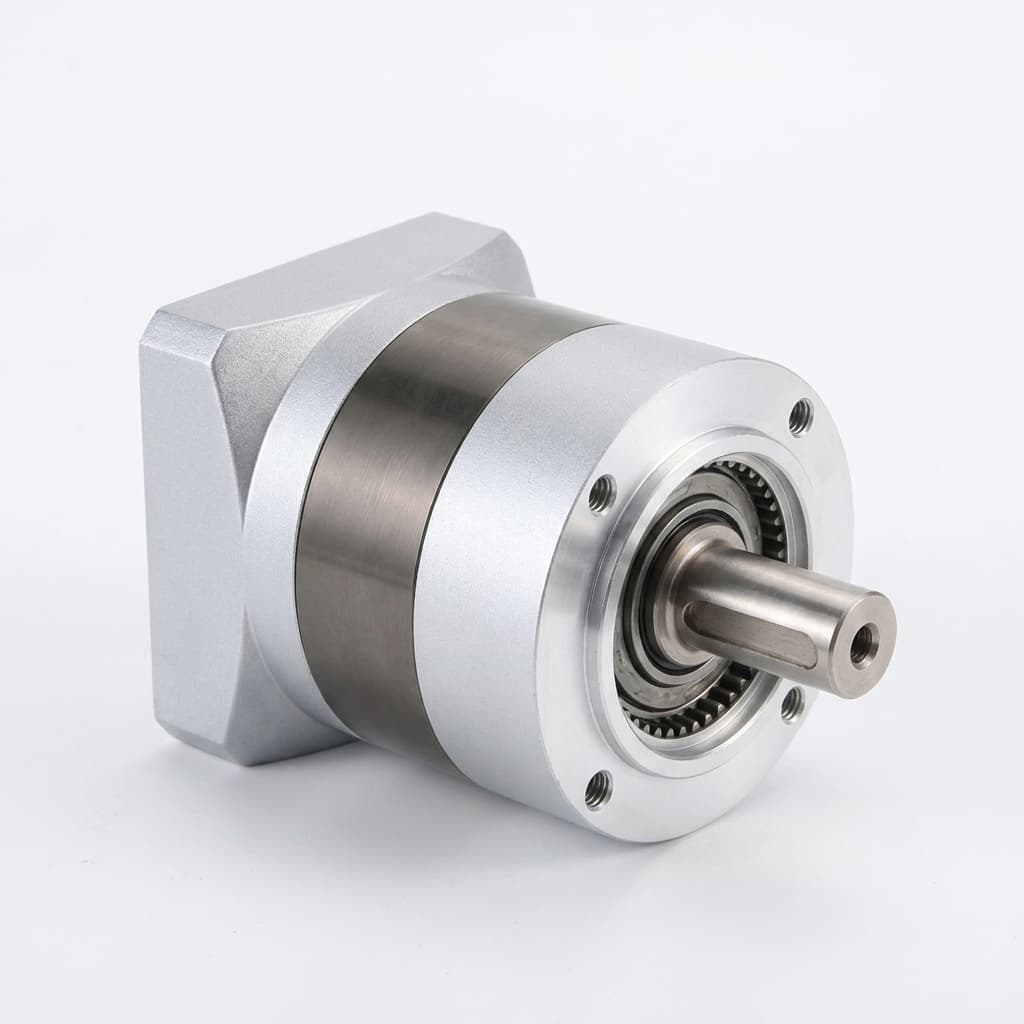
S1 vs S5 Duty Cycles: Thermal Derating in Precision Planetary Gearheads
Compare S1 vs S5 duty cycles for precision planetary gearheads, then use thermal derating checks to avoid overheated servo gearhead failures.
When engineering teams and procurement officers size a precision planetary gearhead for a servo application, they typically focus on three primary mechanical metrics: peak torque, backlash, and inertia ratio. However, a hidden variable often compromises the entire bill of materials (BOM) and leads to catastrophic field failures: thermal capacity.
The mechanical limits of a planetary gearhead—what the gears and bearings can physically withstand before breaking—are often significantly higher than its thermal limits. If a machine runs continuously (S1 duty cycle) but is equipped with a gearhead sized only for intermittent operation (S5 duty cycle), the internal temperatures will rapidly exceed the breakdown threshold of the synthetic grease or oil.
For buyers and importers sourcing OEM gearheads, ignoring the difference between S1 and S5 duty cycles inevitably leads to warranty claims, ruined seals, and seized gearboxes. This guide explains the engineering physics behind duty cycles, how thermal derating works, and how to verify your supplier's sizing calculations. If you are comparing frame sizes or ratio options, use it alongside our precision gearhead product overview, the gear-head motor fundamentals guide, and the inertia matching calculator.
Scope, Date, and Selection Limits
This article reflects application-engineering guidance as of July 26, 2026, for global OEM buyers specifying precision planetary gearheads behind servo motors. It is useful for RFQ screening, supplier quote review, and early frame-size selection, but it does not replace a supplier thermal model, lubricant data sheet, or measured housing-temperature test on the final machine. Ambient temperature, mounting plate material, motor adapter geometry, seal type, lubricant fill, input speed, and duty factor can all move the allowable continuous torque up or down.
The Physics of Gearhead Overheating
Planetary gearheads are highly compact. By design, they offer immense torque density by distributing the load across multiple planet gears. While this geometry is excellent for mechanical rigidity, it is inherently poor at heat dissipation. The small surface area of the housing struggles to shed the heat generated by:
- Gear Mesh Friction: The sliding and rolling friction between the sun, planet, and ring gears.
- Seal Friction: The rubbing of the input and output oil seals against the rotating shafts.
- Bearing Friction: Heat generated by the input and output bearings under high radial and axial loads.
- Lubricant Churning: The viscous resistance of the grease or oil being rapidly displaced by the spinning gears.
In an intermittent application, the gearbox has time to rest and shed this heat into the ambient air or the machine frame. In a continuous application, the heat accumulates until the unit reaches thermal equilibrium. If that equilibrium temperature exceeds the rating of the lubricant (typically around 90°C for standard grease, up to 140°C for specialized synthetic oils) or the FKM/Viton seals, the lubricant separates, loses viscosity, and the metal-on-metal contact destroys the gearhead in a matter of hours.
Defining S1 (Continuous) vs. S5 (Intermittent) Duty
The International Electrotechnical Commission (IEC) standard defines various duty types for electric motors, and those duty-cycle labels are commonly carried into coupled servo gearhead sizing.
S1: Continuous Duty
In an S1 duty cycle, the gearhead operates under a constant load for a sufficient duration to reach thermal equilibrium. The temperature of the gearbox rises and eventually plateaus.
- Rule of Thumb: If the gearhead rotates continuously for more than 20 to 30 minutes, or if the rest periods are too short to allow any meaningful cooling, the application is S1.
- Typical Applications: Conveyor drives, continuous mixing equipment, web tensioning rolls, and extruders.
S5: Intermittent Periodic Duty with Electric Braking
In an S5 duty cycle, the operation consists of a sequence of identical duty cycles, each including a period of acceleration, a period of constant load, a period of rapid deceleration (braking), and a rest period. The rest period allows the gearbox to cool down, meaning it never reaches the maximum thermal equilibrium it would hit under continuous operation.
- Rule of Thumb: Cyclic operation where the running time is less than 20 minutes and the duty factor (ED%) is typically under 60%.
- Typical Applications: Pick-and-place robotics, rotary indexing tables, AGV wheel drives, and packaging machine cross-sealers.
Thermal Curve Profile: S1 vs S5 Duty Cycles
Figure 1: In an S1 cycle, temperature rises steadily until equilibrium. Without thermal derating, it can easily breach the lubricant's critical limit. An S5 cycle allows cooling periods, keeping peak temperatures well below the danger zone.
How Thermal Derating Impacts Gearhead Selection
When a manufacturer publishes a "Nominal Output Torque" (T2N) in their catalog, that figure is almost universally based on an S5 intermittent duty cycle at a nominal input speed (e.g., 3000 RPM) with an ambient temperature of 20°C.
If your application requires S1 continuous duty, you cannot use the T2N rating at face value. You must apply a thermal derating factor. The exact derating formula depends on the manufacturer, the ambient temperature, and the specific gearbox series, but it generally involves reducing the allowable continuous torque by 30% to 50%.
Example Scenario
A design engineer selects a 90mm planetary gearhead rated for 100 Nm nominal torque for a conveyor belt drive running 24/7 (S1 duty). The actual continuous load is 80 Nm.
- Mechanical check: 80 Nm < 100 Nm (Pass).
- Thermal check: The supplier's S1 thermal limit at 3000 RPM is actually 45 Nm.
- Result: The gearhead is severely under-sized for S1 operation. It will overheat, the grease will liquefy and leak, and the gears will seize within weeks. The buyer must either step up to a 120mm/140mm frame size or specify a gearhead with external active cooling/oil-bath lubrication.
For a quick procurement sanity check, ask the supplier to show the continuous thermal torque at the same input speed, ambient temperature, mounting orientation, and duty factor used in your machine. A quote that only lists peak torque, emergency-stop torque, or S5 nominal torque has not yet answered the S1 thermal question.
S1 vs. S5 Application and Sourcing Matrix
To clarify the engineering boundaries, the following structural table outlines how S1 and S5 duty cycles dictate different procurement and design priorities.
| Parameter | S1 Continuous Duty | S5 Intermittent Duty |
|---|---|---|
| Running Time / Rest Ratio | Runs > 20 mins; Duty cycle (ED) > 60% | Runs < 20 mins; Duty cycle (ED) < 60% |
| Thermal Equilibrium | Gearbox reaches and sustains maximum stable temperature. | Gearbox cools down between cycles; never reaches max equilibrium. |
| Primary Sizing Constraint | Thermal dissipation limit (Heat generation). | Mechanical fatigue limit (Tooth bending and bearing load). |
| Lubrication Requirement | High-temperature synthetic oils or premium greases required. | Standard synthetic greases are usually sufficient. |
| Efficiency Sensitivity | Highly critical. A 2% drop in efficiency means massive heat generation. | Less critical. Brief inefficiencies do not cause overheating. |
| Cost Implication | High. Requires over-sizing the frame or adding cooling fins/adapters. | Standard. Catalog ratings apply without severe thermal derating. |
| Typical OEM Examples | Web handling, extruders, heavy continuous conveyors, continuous mixers. | Robotic joints, rotary index tables, pick & place actuators. |
Sourcing Checklist for OEM Buyers
When issuing an RFQ (Request for Quote) for a precision servo gearhead, procurement teams must enforce strict engineering checks to avoid the "thermal trap." Do not accept a quote based solely on mechanical peak torque.
- Define the Duty Cycle (ED%): Explicitly state the acceleration time, constant run time, deceleration time, and rest time in the RFQ.
- Specify Ambient Temperature: A gearbox running S1 in a 40°C factory requires much more derating than one in a 20°C climate-controlled room.
- Verify Thermal Torque (T2T): Ask the supplier to provide the specific continuous thermal torque rating (often labeled T2T or Thermal Limit) for your exact input speed.
- Check Mounting Flange Material: Aluminum machine frames act as excellent heat sinks and can increase the thermal limit by 10-15%. Steel or isolated mounts provide poor heat sinking.
- Consider Housing Upgrades: If S1 is required but space is tight, inquire about gearheads with ribbed housings or liquid-cooled motor adapter plates.
- Validate Lubricant Spec: Ensure the lubricant specified can handle >90°C continuous operation without phase separation.
Conclusion: Don't Buy Mechanical Specs for a Thermal Problem
Precision planetary gearheads are robust mechanical devices, but heat is their absolute enemy. Treating an S1 continuous application like an S5 intermittent application is a guaranteed path to field failure, expensive downtime, and fractured supplier relationships.
Before placing a volume order, ensure your engineering team and your gearhead supplier are perfectly aligned on the thermal derating calculations.
Need to verify if your gearhead sizing is safe for continuous operation? Contact our engineering team to review your load profile, duty cycle, and ambient conditions to ensure a flawless, long-lasting deployment.
Frequently Asked Questions (FAQ)
Q: Can I use an intermittent-rated (S5) gearhead in a continuous (S1) application if I just add external fans? A: External fans can increase the thermal capacity by about 10-20%, but they rarely bridge the gap between an S5 rating and S1 continuous equilibrium. You typically need to either upsize the gearhead or use oil-bath lubrication.
Q: How do I know if my application is S1 or S5? A: A general rule of thumb is that if the gearbox runs under constant load for more than 20 to 30 minutes without a cool-down period, it should be treated as S1.
Q: Does planetary gearhead efficiency decrease as it heats up? A: Yes. As temperatures rise, mechanical clearances change and the viscosity of the grease drops. This can increase internal friction (churning losses) and further accelerate heat generation, leading to thermal runaway if derating isn't applied.
Sources and References
- Machine Design: Planetary gears — A review of basic design criteria and new options for sizing - Details the breakdown of lubricants and thermal failure modes under continuous planetary operation.
- Motion Control Tips: FAQ: What are efficiency requirements for continuous vs. intermittent duty gearmotors? - Analyzes the definitions of S1 and S5 running times in motion control.
- Parvalux: Duty Cycle Guide - Manufacturer guide explaining S1 continuous duty and intermittent duty-cycle definitions used in motor and geared-motor selection.
Author

Categories
More Posts

NEMA 23 vs NEMA 34 Gearhead: Which Size for Your Application?
Project-level NEMA 23 vs NEMA 34 decision method using torque reserve, inertia behavior, thermal margin, and lifecycle risk.
RFQ Checklist for Planetary Gearhead OEM Projects: From Drawing to Pilot Lot
RFQ gate framework for planetary gearhead OEM programs, covering boundary definition, acceptance methods, quote comparability, and release logic.

AGV/AMR Wheel Drive Gearheads: Radial Load Constraints and Bearing Life Sourcing Guide
How to specify and source precision gearheads for Automated Guided Vehicles (AGVs) and Autonomous Mobile Robots (AMRs) to prevent premature flange bearing failures.